
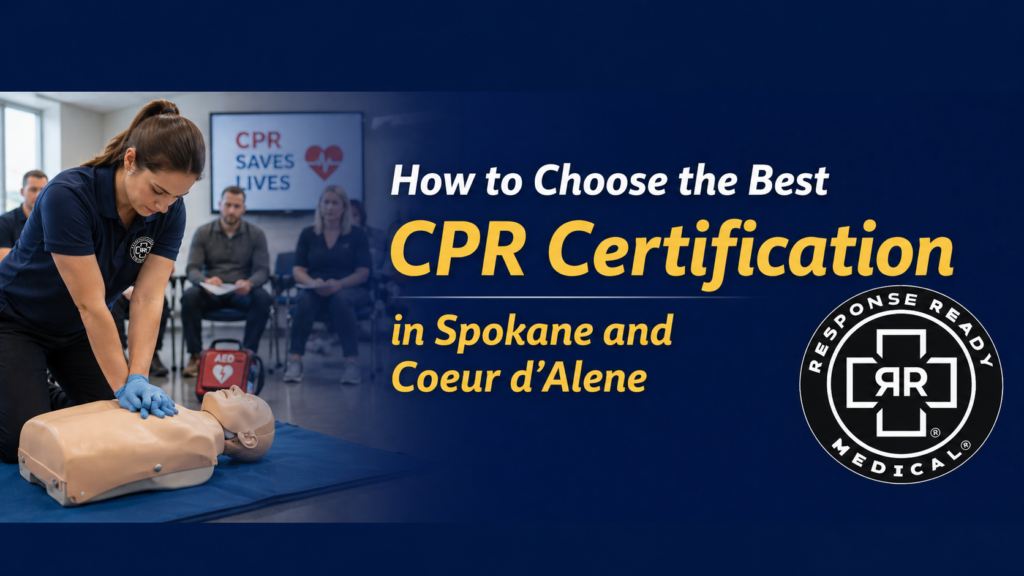
How to Choose the Best CPR Certification in Spokane and Coeur d’Alene
Table of Contents
- Introduction
- Why Choosing the Right CPR Certification Matters
- Understanding Different Types of CPR Certification
- Key Factors to Look for in a Training Provider
- Hands On Training vs Online Only Courses
- Nationally Recognized Certifications Explained
- Instructor Experience and Why It Matters
- Local Relevance in Spokane and Coeur d’Alene
- Red Flags to Avoid When Choosing a CPR Class
- Why Response Ready Medical Stands Out
- Conclusion
- CPR Certification FAQ
Introduction
Choosing a CPR certification course is one of the most important decisions you can make when it comes to emergency preparedness. Whether you need certification for a job or want to be ready to help in a crisis, the quality of your training will directly impact your ability to respond.
In Spokane Washington and Coeur d’Alene Idaho, there are many options available. However, not all CPR certification programs offer the same level of training, credibility, or real world effectiveness.
This guide will help you understand how to choose the best CPR certification so you can train with confidence and be fully prepared when it matters most.
Why Choosing the Right CPR Certification Matters
CPR is not just a skill. It is a lifesaving intervention that must be performed correctly under pressure.
Low quality training may provide a certification card, but it often fails to build confidence or competence. During a real emergency, hesitation or incorrect technique can have serious consequences.
High quality CPR training focuses on:
- Immediate recognition of cardiac arrest
- Proper technique and repetition
- Decision making in stressful situations
- Confidence to act without hesitation
Choosing the right certification ensures you are truly prepared.
Understanding Different Types of CPR Certification
Not all CPR certifications are the same. Courses may include basic CPR and AED training, CPR combined with First Aid, or advanced healthcare level certification.
For most individuals and workplaces, CPR and AED training or CPR with First Aid is sufficient. Healthcare professionals may require more advanced training.
Understanding your needs helps narrow your options.
Key Factors to Look for in a Training Provider
When evaluating CPR training in Spokane or Coeur d’Alene, consider the following:
Certification recognition is critical. Choose a provider that offers nationally recognized certification such as HSI.
Hands on training is essential. You should practice CPR techniques under instructor guidance.
Instructor qualifications matter. Experienced instructors provide deeper insight and real world context.
Class size and structure affect learning. Smaller classes allow for more personalized instruction.
Hands On Training vs Online Only Courses
Online CPR courses may appear convenient, but they often lack practical skill development. Watching videos does not prepare you to perform CPR in a real emergency.
Hands on training builds muscle memory and confidence. It allows instructors to correct technique and provide feedback.
For most situations, in person training is the best choice.
Nationally Recognized Certifications Explained
Nationally recognized certifications ensure your training meets accepted standards across industries.
HSI certification is widely accepted and respected. It provides consistency, credibility, and alignment with current medical guidelines.
This is especially important for employment and compliance.
Instructor Experience and Why It Matters
An experienced instructor brings real world knowledge into the classroom. This helps students understand how skills apply outside of training.
Response Ready Medical instructors are licensed EMTs and paramedics. They teach from real experience, not just curriculum.
This enhances learning and confidence.
Local Relevance in Spokane and Coeur d’Alene
Local training providers understand the specific risks and environments of the region. Spokane and Coeur d’Alene include workplaces, outdoor recreation areas, and diverse community settings.
Training that reflects local realities is more effective.
Red Flags to Avoid When Choosing a CPR Class
Be cautious of programs that:
- Offer certification without hands on practice
- Promise extremely fast completion with minimal instruction
- Lack recognized certification
- Provide limited instructor interaction
These are signs of low quality training.
Why Response Ready Medical Stands Out
Response Ready Medical combines HSI certification with EMS level instruction. Training is hands on, practical, and designed for real emergencies.
Courses are available throughout Spokane and Coeur d’Alene with flexible scheduling and on site options.
Conclusion
Choosing the best CPR certification is about more than convenience. It is about ensuring you are prepared to act when lives are on the line.
With the right training provider, you gain confidence, competence, and the ability to make a difference.